
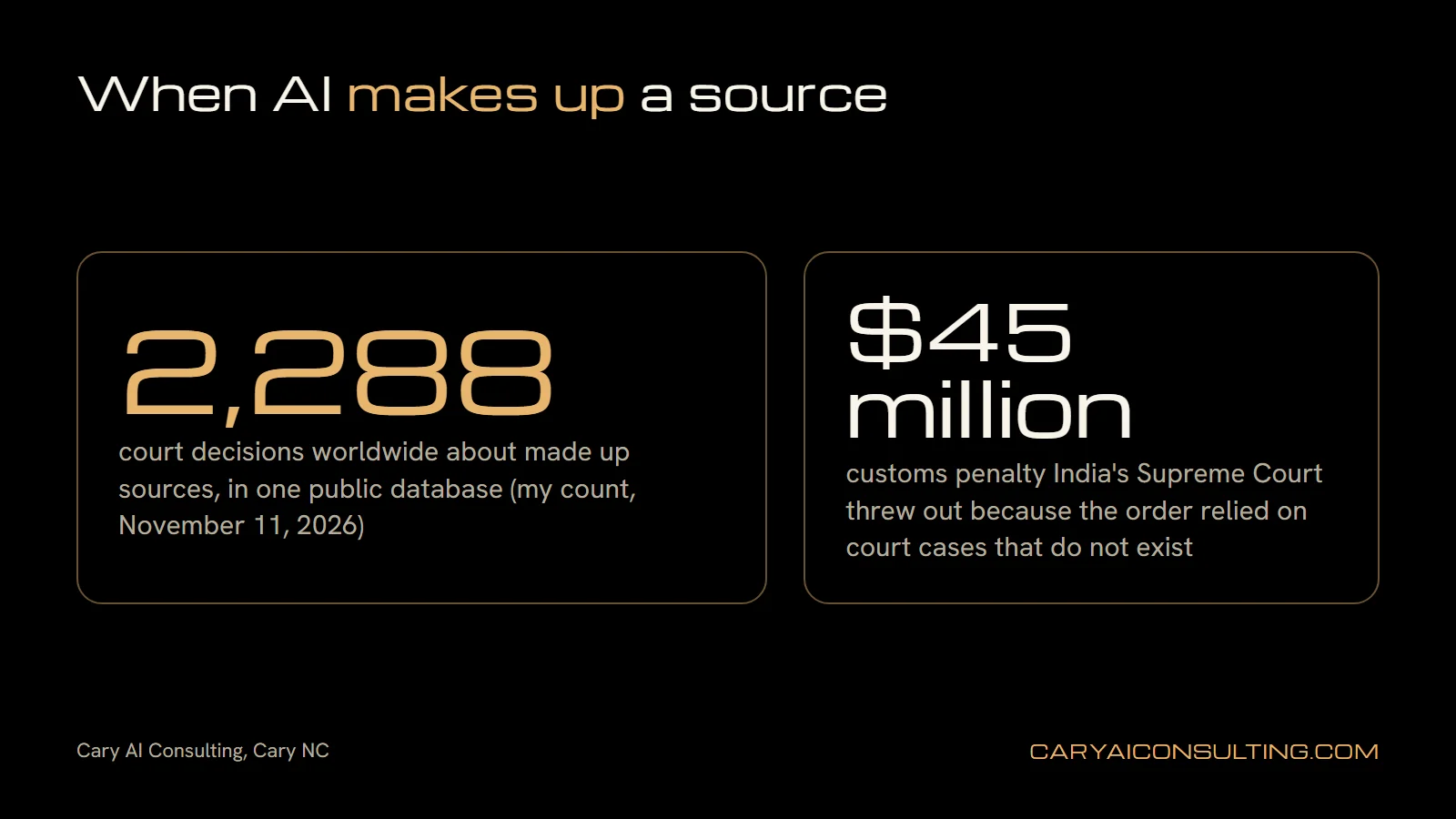
India's Supreme Court threw out a customs penalty of about 45 million dollars because the order relied on court cases that do not exist.
Then, on October 30, 2026, the Bombay High Court threw out another customs order after the same complaint.
There is an important distinction here. The Bombay High Court did not find that AI wrote the order. That was the company's claim, and the court quashed the order by consent. The diamond accusation behind the 45 million dollar penalty has not been decided by any court either.
But made up sources are a real problem.
I looked through a public database of court decisions like these on November 11. My count was 2,288 worldwide.
Why AI makes things up
ChatGPT and Claude are built to predict the most likely words that come next.
Usually, that works pretty well. You ask a question and get an answer that makes sense.
But sometimes the chatbot gives you a court case, a law or a quote that sounds perfectly reasonable.
There is just one small problem. It does not exist.
And the chatbot does not know it made a mistake. It delivers the wrong answer with exactly the same confidence as the right one.
That is what makes this so easy to miss.
Why this matters for a small business
Most small business owners are not writing court orders. But there are plenty of other places where a made up source could cause trouble.
Maybe you ask AI to write a customer letter that mentions a rule. Or a proposal that uses a specific number. Maybe you publish a blog post that refers to a study.
You might even ask it about a law that affects your business.
If the chatbot invents the source and you use it, guess whose name is on that document.
Yours.
Your customer is not going to care which chatbot wrote it.
The one habit
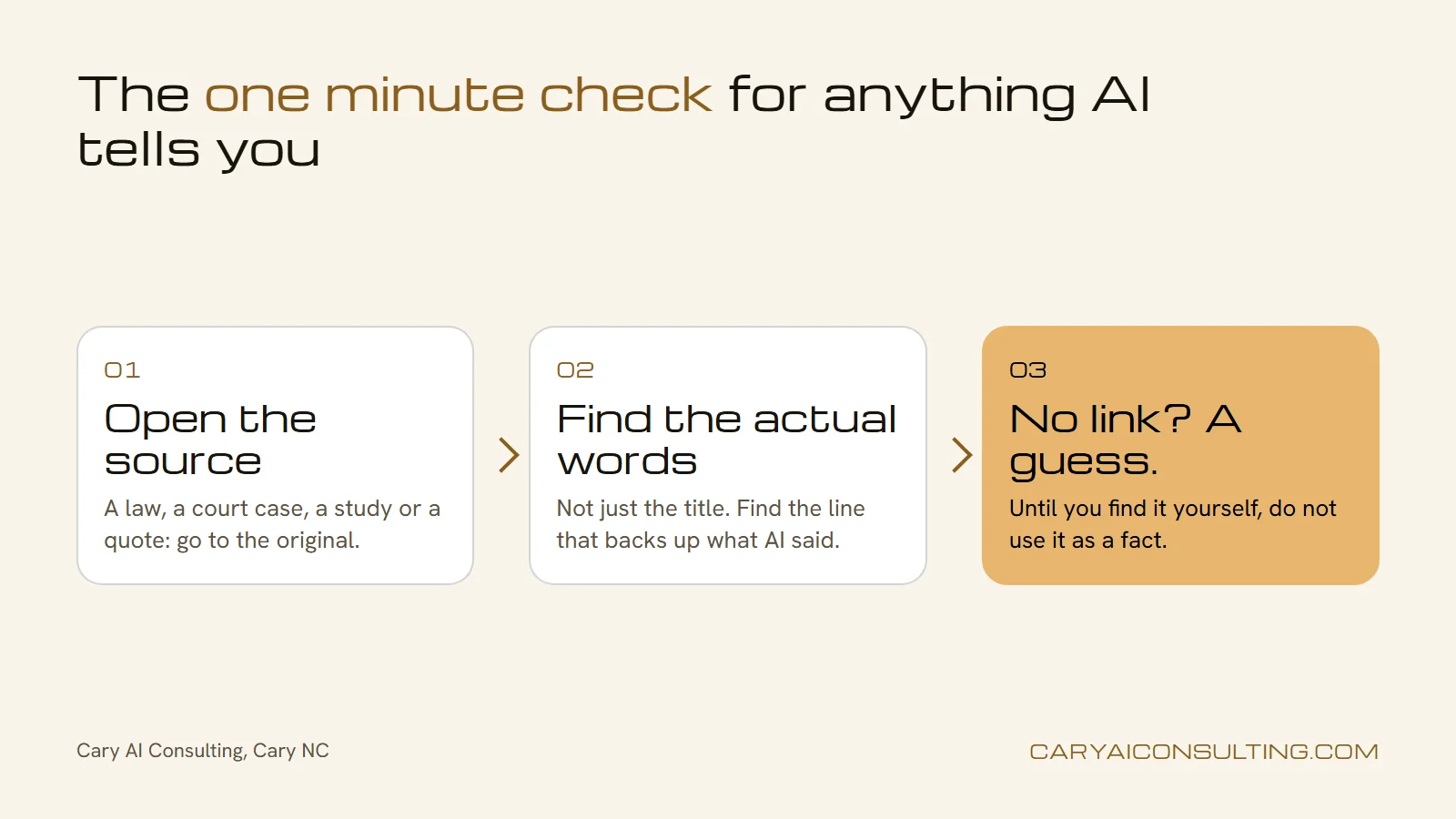
I follow one simple rule whenever AI gives me a source. I check it myself.
Here is how.
- Open the source. If AI gives you a law, court case, study or quote, go to the original source.
- Find the actual words. Do not just trust the title. Find the line that backs up what AI told you.
- No link? Treat it as a guess. Until you can find the source yourself, do not use it as a fact.
That is all there is to it.
It takes a minute. And I would much rather spend that minute checking a source than explain to a customer why I quoted something that never existed.
I use AI for almost everything I build. I still check every source it gives me.
There is nothing wrong with letting AI do some of the work. Just do not let it skip the part where someone checks whether the answer is right.
What does your software cost a year?Tick the apps you pay for and see them next to a $20 Claude plan. Free calculator.Watch the video
In the video below, I go through both court orders, show how I counted the 2,288 decisions, and explain why chatbots sometimes invent court cases.
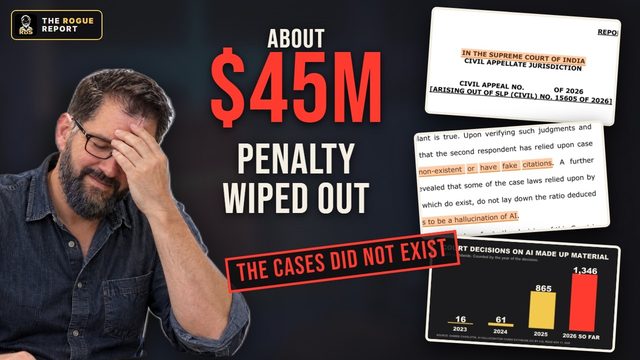 Watch on YouTube: A $45 Million Diamond Fine Got Tossed Because AI Faked the Cases
If you want to use AI in your business but are not sure what you can trust, book a free call. I will show you where AI can help and where you still need a person checking the work.